Business interfaces
ERP / MES / OMS / TMS: define master data, order ownership, status feedback and reconciliation rules.

INDUSTRIAL SOFTWARE & AUTOMATION
From warehouse decisions to machine movements. Software, digital twins and engineering that connect your operation.
SOFTWARE. CONTROLS. SYSTEMS. IN FLOW.

THE SOFTWARE STACK
A clear path from inventory and orders to execution and equipment control. Explore where each system fits.
ERP / MES / OMS / TMS: define master data, order ownership, status feedback and reconciliation rules.
WMS → WES → WCS: agree task identity, cancellation, retry and completion events across every handoff.
Scope deployment, access roles, event retention, backup and recovery around the facility’s operating requirements.

THE OPERATION, IN PERSPECTIVE
3D DIGITAL TWIN
Connect the facility model to identified equipment, task events and location data. Specify data freshness and disconnected states so operators can distinguish a live condition from an outdated view.
Plan and compareEvaluate rack layout, transport paths and buffer locations against material profiles and agreed throughput assumptions.
Monitor and investigateLink equipment states and alarm locations to task context, timestamps and exception histories.
Replay and improveUse recorded events to review congestion and interruptions; evaluate strategy changes with a separately defined simulation model.
SYSTEMS ARCHITECTURE
Defined responsibilities. Explicit handoffs.
A shared operational context.
WMS → WES: allocated work / WES → WCS: transport missions / Feedback returns to the owning layer
Equipment identity + location + task events + time stamps → spatial state, alarm localization and event replay.
Reference architecture. Deployment boundaries and data interfaces are agreed per project. Equipment safety remains within the designated safety control system.
BUILT AROUND THE OPERATION
Seven industry perspectives, each with a process blueprint, software responsibilities, equipment considerations and validation priorities. These are proposed approaches, configured during project discovery.
TEAM PROJECT EXPERIENCE
Project experience of FLOWVERN’s founders and core team across production logistics, warehouse automation and order fulfillment. Explore application, equipment and software configurations by industry.
ENGINEERING & INTEGRATION
FLOWVERN connects system planning, software and automation integration, with the operational requirements kept in view throughout.
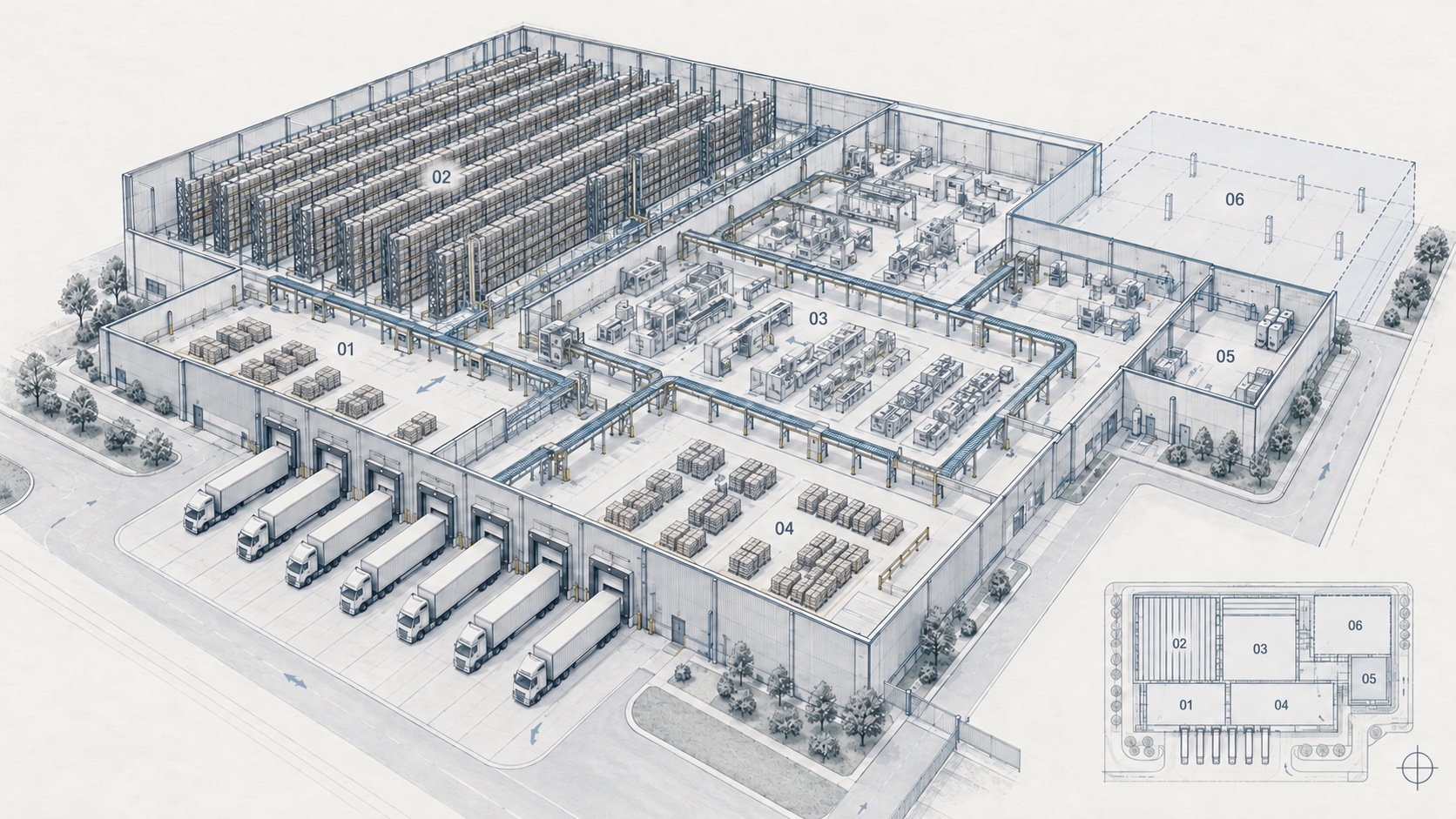
DESIGN THE WHOLE SYSTEM
Profile SKU dimensions, load carriers, inventory cover and hourly demand. Separate sustained capacity from peak bursts; size storage, buffers and workstations around the actual operating calendar.
Compare pallet AS/RS, Miniload, shuttles and mobile transport against load, travel distance and expansion needs. Include maintenance access, manual exception handling and facility constraints.
Define master-data ownership, task state transitions and equipment telegrams. Specify acknowledgements, duplicate handling, timeouts and reconciliation before connecting ERP/MES to the control layer.
Survey installed equipment, PLC programs and legacy interfaces. Identify reusable assets and dependencies, then plan staged cutover, temporary workflows and rollback conditions.
FROM DESIGN TO DELIVERY
Carry the approved layout, interface contracts and operating scenarios into controls implementation, installation coordination and integrated testing. Every handover needs a clear state, responsible owner and recovery path.

PROJECT DELIVERABLES
COMMISSIONING & ACCEPTANCE
Verify agreed logic, signal sequences and fault cases before site commissioning where the project permits.
Exercise end-to-end flows with representative loads: normal operation, blocked routes, lost acknowledgements, restart and manual recovery.
Agree measurement windows, order mix, staffing and downtime rules. Record outstanding items, ownership and closure conditions.
From a new facility to the next stage of an existing operation.
Discuss your project ↗APPLIED ALGORITHM RESEARCH
Our AI algorithm research starts with concrete industrial problems: how work is scheduled, how materials move and how systems respond to change.
Research directions · evaluated against operational requirements
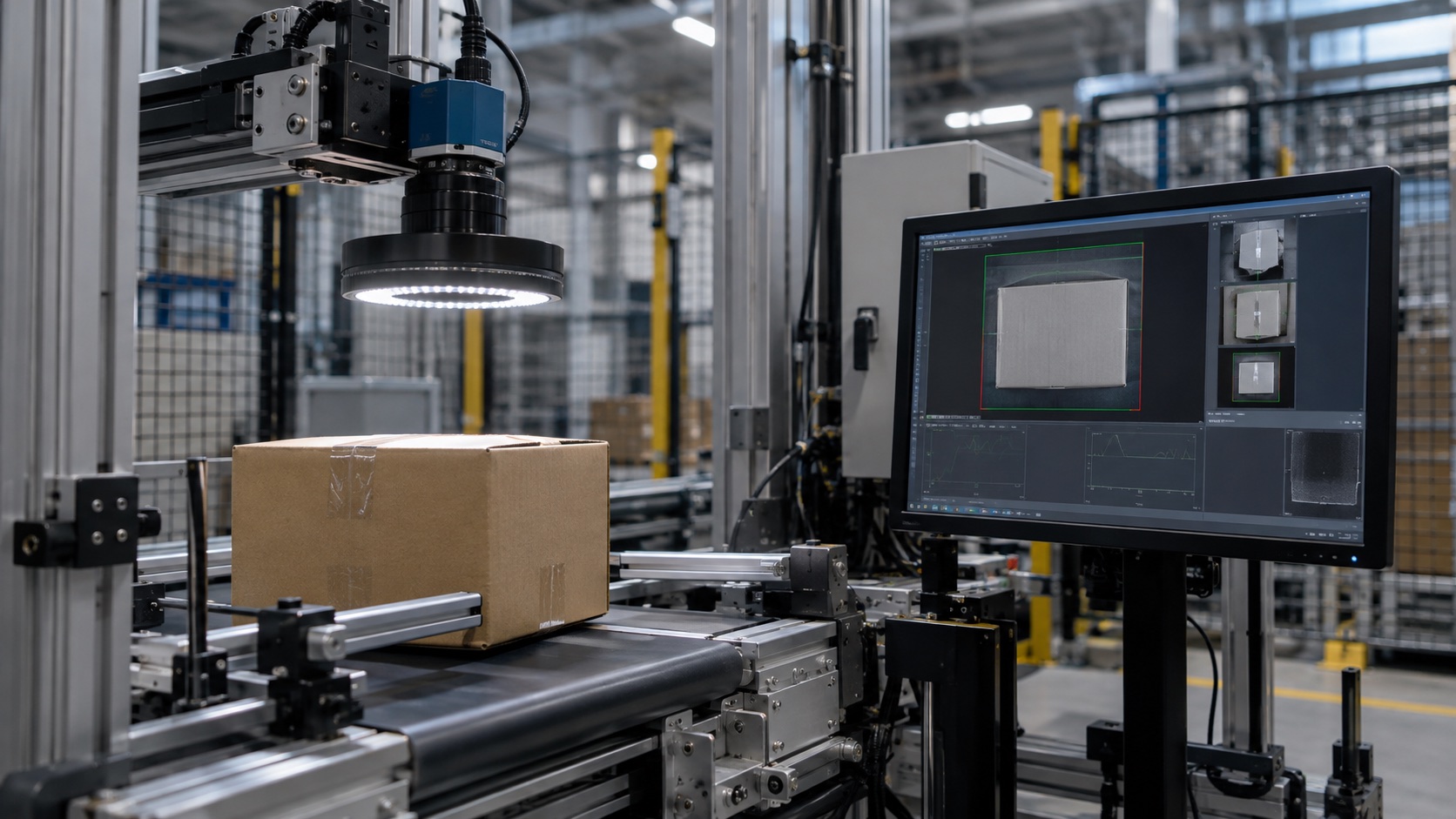
FROM HYPOTHESIS TO VALIDATION
Research is organized around a defined operating problem, available data and a baseline strategy. The following are research and validation directions; deployment scope is determined after feasibility assessment.
Balance urgent work, shared equipment and downstream buffers.
Resolve transport conflicts while respecting one-way routes and reserved zones.
Detect item or packaging differences and route uncertain results to human review.
Study replenishment timing, item placement and changes in order mix.
Explore how layouts, buffers and dispatch rules behave under changing demand and equipment availability.
Identify recurring interruptions across tasks, interfaces and equipment, and help operators narrow the investigation.
Baseline → offline evaluation → shadow operation → controlled pilot → monitored release
Version datasets and models; retain rule-based fallback and human intervention. Monitor input drift and operational exceptions before extending the application.
ENGINEERING THE EXPERIMENT
Specify the decision interval, constraints, baseline policy and success criteria. Report trade-offs rather than a single isolated score.
Align equipment and task identifiers, reconcile timestamps and audit missing or duplicated events. Split training and evaluation data by time or site where appropriate.
Evaluate peak arrivals, rush orders, blocked routes, device downtime and partial connectivity. Repeat stochastic trials and document the range of results.
Use shadow evaluation before limited operational trials. Agree version ownership, observation windows, rollback triggers and the person authorized to intervene.
A problem and constraint specification; a dataset and annotation specification; reproducible baseline and candidate experiments; a comparison report with limitations; and a pilot, monitoring and rollback plan. Scope is agreed for each research engagement.
Discuss a research challenge ↗ABOUT FLOWVERN
FLOWVERN brings together warehouse software, equipment control, 3D digital twins and automation engineering to address the entire material-flow system.
Our approach begins with material and information flows: establish the operating baseline, define responsibilities across software and equipment, and validate the system against agreed scenarios. Projects can focus on a software layer, a facility upgrade or integrated planning and delivery.
FLOWVERN TECHNOLOGIES, INC.Planned U.S. company · Formation in progress
CUSTOMER SERVICE
Plan support around the facility’s operating hours, critical workflows and team responsibilities—from launch readiness to incident handling and lifecycle improvement.
Prepare role-based training for operators, supervisors and maintenance teams. Rehearse critical workflows, exception handling and escalation routes before the agreed launch window.
Collect timestamps, affected tasks, equipment states and recent changes. Prioritize by business impact, agree containment actions and coordinate software or equipment specialists.
Review service health, interface queues, event logs, storage growth and backup status. Schedule patch assessment and recovery exercises within approved maintenance windows.
Review bottlenecks and recurring exceptions against an operating baseline. Assess parameter changes, capacity expansion and upgrades with regression testing and rollback plans.
A TRACEABLE SUPPORT PROCESS
Describe impact, time and evidence.
Confirm severity and responsible teams.
Agree safe workarounds and recovery steps.
Verify operations and document the cause.
Track preventive actions and follow-up changes.
Support hours, reporting channels, severity definitions, response targets, remote access, site attendance and software/equipment responsibilities are specified in the service agreement.
YOUR NEXT PROJECT
A useful brief includes your industry, facility type, SKU and load profile, average and peak order volumes, existing ERP/MES and equipment, current bottlenecks and launch window. Estimates are welcome at the planning stage.
Your brief stays in your browser. Download a copy for your team; this form does not send an inquiry.